
Saturday, May 24, 2008

Sunday, April 27, 2008
Looking for the Mouse
A very interesting big-think article.
I was recently reminded of some reading I did in college, way back in the last century, by a British historian arguing that the critical technology, for the early phase of the industrial revolution, was gin.
The transformation from rural to urban life was so sudden, and so wrenching, that the only thing society could do to manage was to drink itself into a stupor for a generation. The stories from that era are amazing--there were gin pushcarts working their way through the streets of London.
And it wasn't until society woke up from that collective bender that we actually started to get the institutional structures that we associate with the industrial revolution today. Things like public libraries and museums, increasingly broad education for children, elected leaders--a lot of things we like--didn't happen until having all of those people together stopped seeming like a crisis and started seeming like an asset.
It wasn't until people started thinking of this as a vast civic surplus, one they could design for rather than just dissipate, that we started to get what we think of now as an industrial society.
If I had to pick the critical technology for the 20th century, the bit of social lubricant without which the wheels would've come off the whole enterprise, I'd say it was the sitcom. Starting with the Second World War a whole series of things happened=rising GDP per capita, rising educational attainment, rising life expectancy and, critically, a rising number of people who were working five-day work weeks. For the first time, society forced onto an enormous number of its citizens the requirement to manage something they had never had to manage before--free time.
And what did we do with that free time? Well, mostly we spent it watching TV.
We did that for decades. We watched I Love Lucy. We watched Gilligan's Island. We watch Malcolm in the Middle. We watch Desperate Housewives. Desperate Housewives essentially functioned as a kind of cognitive heat sink, dissipating thinking that might otherwise have built up and caused society to overheat.
And it's only now, as we're waking up from that collective bender, that we're starting to see the cognitive surplus as an asset rather than as a crisis. We're seeing things being designed to take advantage of that surplus, to deploy it in ways more engaging than just having a TV in everybody's basement.
Read the rest. No summary I give will do it justice.
Saturday, April 12, 2008
Sunday, December 2, 2007
Sunday, September 23, 2007
Friday, September 7, 2007
What I've been reading
Just finished a John LeCarré kick: went through The Spy Who Came in from the Cold, Tinker, Tailor, Soldier, Spy, The Honourable Schoolboy, Smiley's People, A Small Town in Germany and The Perfect Spy. Next up is Spook Country, most definitely not a John LeCarré book.
Sanity
If a neat desk is the sign of a sick mind, I'm far more sane than anyone has ever given me credit for being.


Tuesday, September 4, 2007
Not getting paid sucks
Especially when you've worked hard for two months. I'm not sure if the fact that the place which wanted me to work for free was shocked--SHOCKED!--I would mind not being paid is a bit of black comedy or just par for the corporate course.
Sunday, August 5, 2007
Rock is dead
I'm not much for deep thoughts on here, but one has been bugging me lately, so I might as well write it down.
I've been reading about the decline in CD sales for the past few years, and I've watched it, as the Tower Records stores on Broadway and in Lincoln Center closed. I've also read the reasons given by the RIAA, none of which ring true to me. As far as I can tell, the RIAA is doing what all monopolists do, which is to protect its control of scarce assets at all costs without paying attention to what's really happening.
Which is what? It's not all piracy. The music industry has survived all of the technologies which were supposed to kill it. Piracy isn't the problem. I think what's happening is much simpler and much more basic. I think that rock and roll, the dominant musical form of the past fifty years, has run its course.
If you put aside all of the 'I'm in love'/'She broke my heart'/'I want to party all night long' songs, which are a constant, the social and political thrust of rock and roll, which came of age in the mid 1960s, seems to me to be a victim of its own success. The social mores which rock and roll attacked have fallen by the wayside, and while we don't live in the utopia which some envisioned during and after the Summer of Love, we live in a country which is much more socially tolerant and open than it was. Legalized discrimination is mostly a thing of the past, and the social institutionalization of that prejudice is, IMO, fading. The restrictive sexual mores of the 1940s and 1950s are certainly gone, and we are much more willing to talk about the other "dark" sides of life some social conservatives wish to ignore. The Vietnam was was ended, and most of the country has now regained it senses with respect to the disaster in Iraq. I actually see the frantic conservative backlash against the changes wrought in the U.S. since the end of WWII as a sign of the success of those very changes, the last desperate gasp of a generation and a mindset which will quite literally be dead in twenty or thirty years.
But I think that's only half the battle. I think the real problem for rock and roll is that the symbols used by the musicians to signify freedom and rebellion against the social norm have all been normalized and co-opted themselves. There are tattooed and pierced corporate lawyers who ride Harleys on the weekends. Skateboarding, once a dangerous sport practiced by punks and losers on the fringes of the culture, is now a multi-billion dollar a year industry filled with professional athletes. The fact that these athletes are covered in tattoos and jingling with jewelry doesn't detract from that fact they're as co-opted and corralled as was the Man in the Grey Flannel Suit, surrounded at all times by lawyers and publicists and image consultants. And so any group which points to these symbols as evidence of an outsider status, or uses them as a tool with which to question the standing social order, only points back to that order. Skateboarding these days is about as rebellious as being an accountant, and riding a Harley just means your Wall Street firm gave you a nice year-end bonus.
Beyond this, the behavior of Zeppelin or Keith Moon, once so shocking, is now barely worth a raised eyebrow. If you're the child of a baby boomer, there's a chance your parents have done more drugs and had more sex than you have. With the gradual acceptance of twelve step programs and rehab facilities into our national conversation, and the willingness to see drug addition for what it is, drug- and booze-fueled behavior is no longer a stand against the Man, but merely the sign that someone has a problem they need to face. Trashing a hotel room does not mean you're channeling the spirit of Rimbaud. It means your lawyer will make a lot of money negotiating a settlement with the hotel chain and you will make a sheepish PSA about the problem of addiction.
Or, put more simply, all that shit is now boring. And boring is the death of any art form.
That said, what's next? Where does the next social earthquake come from? I don't know. Certainly not rap and hip hop, which is a commodified as a Gap ad. Between 1998 and 1990 Public Enemy released two albums which are, I think, the highest point of hip hop's ability to combine artistic and commercial success, It Takes a Nation of Millions to Hold Us Back and Fear of a Black Planet. But Public Enemy's strident brilliance gave way to gangsta rap, which provided an easy to use template for both artists and record companies to latch onto. Once set, the form commidified quickly. Punk, officially dead since 1987, has finally been rendered safe by Green Day and friends and now gets spit back as pop-punk, a term unimaginable twenty years ago.
I don't know where the next Big Thing is coming from, but I think I have seen the end of the Last Big Thing. Motor's off, and I'm just waiting for the wheels to stop spinning. I'm just wondering how it will end. Will rock morph into something else, something new and frightening and full of promise? Or will it be supplanted by something I can't imagine and end up like the Rat Pack in those famous ad-libbed concerts in Vegas, basking in the limelight and unaware they're singing at a funeral?
Thursday, July 26, 2007
Pointedly ironic
My favorite sign in New York, on 34th between Fifth and Sixth.

Can't make this shit up.

Can't make this shit up.
Thursday, July 19, 2007
Street go boom!
So, I was working right next door to the steam explosion in Manhattan yesterday. It was my first day on the gig. I've heard of hazing the new guy, but this is silly.
I was on the fifth floor. There was a noise like a jet engine, which the bunch of us noticed at about the same time, which led to several simultaneous cries "what is that?" I looked out the window to see a huge geyser coming out of the middle of the street and people running like hell down the street to get away. The first thing to go through my head was, "shit, someone bombed the subway." Of course, the bunch of us all gather near the window, looking down--nothing dangerous about pressing your face up to glass when something large is exploding near by. For second it looked like one of the buildings next door had come down. In hindsight it was just the mud mixed in with the steam, which looks remarkably like the pulverized concrete dust which was everywhere on 9/11. I think it was about then my heart moved up into my throat and decided to stay there for a while.
Someone with a clue started yelling to evacuate the floor, which we did, which led to one of those weird scenes which reminded me more of 9/11: hundreds of people calmly going down the emergency stairs, all with the same question ("what's happening?") and the same answer ("I don't know"). Out on the street it quickly became clear that this wasn't a terrorist thing: there was no smell of something destroyed like there was on 9/11, there was no debris raining down on us and you could hear the steam continuing to force its was out, like the neighbor's leaf blower turned up to eleven. The studio manager made an executive decision that the building was closed for the rest of the day, which was my signal to walk downtown and hook up with my best friend. After all the excitement, It took a few hours for me to calm down. In the end I got today off as well.
Can't wait to see what they have in store for the new guy tomorrow.
Took this as I was walking home:

All in all a very 21st century accident: the street was filled with people taking pictures on their cel phones.
I was on the fifth floor. There was a noise like a jet engine, which the bunch of us noticed at about the same time, which led to several simultaneous cries "what is that?" I looked out the window to see a huge geyser coming out of the middle of the street and people running like hell down the street to get away. The first thing to go through my head was, "shit, someone bombed the subway." Of course, the bunch of us all gather near the window, looking down--nothing dangerous about pressing your face up to glass when something large is exploding near by. For second it looked like one of the buildings next door had come down. In hindsight it was just the mud mixed in with the steam, which looks remarkably like the pulverized concrete dust which was everywhere on 9/11. I think it was about then my heart moved up into my throat and decided to stay there for a while.
Someone with a clue started yelling to evacuate the floor, which we did, which led to one of those weird scenes which reminded me more of 9/11: hundreds of people calmly going down the emergency stairs, all with the same question ("what's happening?") and the same answer ("I don't know"). Out on the street it quickly became clear that this wasn't a terrorist thing: there was no smell of something destroyed like there was on 9/11, there was no debris raining down on us and you could hear the steam continuing to force its was out, like the neighbor's leaf blower turned up to eleven. The studio manager made an executive decision that the building was closed for the rest of the day, which was my signal to walk downtown and hook up with my best friend. After all the excitement, It took a few hours for me to calm down. In the end I got today off as well.
Can't wait to see what they have in store for the new guy tomorrow.
Took this as I was walking home:

All in all a very 21st century accident: the street was filled with people taking pictures on their cel phones.
Saturday, July 7, 2007
The Loneliest Street Lamp


No, not the title of a maudlin children's story, but an abused street lamp on the Henry Hudson Parkway across the street from Fort Tryon Park. The bike path runs along the uptown lanes, above the downtown lanes. I think this lamp used to be a flashing yellow to warn people about the park entrance. It isn't anymore. I don't know if that's because NYDOT decided the park entrance doesn't need a warning signal, or if they just don't care anymore.
Also, I'm working on another short story, I yam, I yam.
Monday, June 4, 2007

Saturday, June 2, 2007
Radical Trinidadians?
NY1 is all abuzz this afternoon as I struggle into consciousness with the story of a foiled plot to blow up a fuel pipeline at JFK:
Three people have been arrested and one other is being sought in a plot to blow up John F. Kennedy International Airport.
Law enforcement officials said Saturday at a press conference in Lower Manhattan that the plot, which never got passed the planning stage, involved a plan to set off explosives in a jet fuel pipeline that feeds through the airport and runs through residential neighborhoods.
According to a law enforcement source, the 40-mile pipeline brings aviation fuel from a facility in Linden, New Jersey, through Staten Island, Brooklyn, and Queens to the airport.
Now, the story's developing, as they say, but one of NY1's soundbites as I listened was "radical Trinidadian groups". What is a radical Trinidadian group? One which passes the Dutchie on the right hand side?
Thanks. I'll be here all week. Don't forget to tip your waitstaff.
Sunday, April 29, 2007
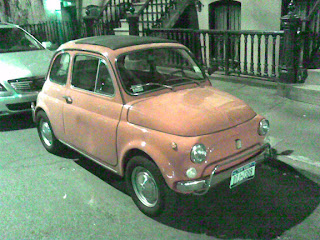
I am enough of a former car nut
To recognize a Volkswagen with an Italian accent:
In a similar vein, one of the wildest rides I've ever been on was being in the backseat of a Citroen 2CV, driven by a crazy Belgian, as it stormed along "roads" through fields near Brussels. The "roads", hard packed dirt and usually driven on by tractors, have been in use for years, so much so that the fields around them have slowly grown until they're higher than the "roads". Imagine a flat, dirt bobsled course and you have the idea. I don't think we got over 50 miles an hour, but it felt like three hundred. . .

In a similar vein, one of the wildest rides I've ever been on was being in the backseat of a Citroen 2CV, driven by a crazy Belgian, as it stormed along "roads" through fields near Brussels. The "roads", hard packed dirt and usually driven on by tractors, have been in use for years, so much so that the fields around them have slowly grown until they're higher than the "roads". Imagine a flat, dirt bobsled course and you have the idea. I don't think we got over 50 miles an hour, but it felt like three hundred. . .
Friday, April 20, 2007
Bright Pretty Things
Although the gig I'm on seems increasingly pointless and frustrating, there are some nice things about being in Midtown at three in the morning. Things are all lit up and pretty:


I also found my first Taxi Master yesterday. Caught a cab home at zero dark thirty and went from 49th and Sixth all the way downtown to my house without hitting a single spotlight. It was a little bit of Manhattan satori.
Sunday, April 15, 2007
Today's installment of It's a Small and Increasingly Funny World
The Syrian guy who works in the health food store across the street from me answering his cel phone with, "how you, playa?"
Monday, April 9, 2007

Wednesday, April 4, 2007
Reality? Wazzat?
It's getting to where I can't tell the war footage from video games. I swear, while I was watching this, the part of my brain which likes blinking lights and blowing things up was wondering whether my computer had the horsepower to play this game.
(I also like how the people in the video are labeled "terrorists", despite the fact they're Iraqis fighting in their home country.)
Thursday, March 29, 2007
Paid for squat
I'm currently getting paid to sit around and do nothing. Even more, I get paid for a full eight hours even if I leave after five.
It's killing me. So much for my dreams of being fabulously wealth and completely indolent.
It's killing me. So much for my dreams of being fabulously wealth and completely indolent.
Subscribe to:
Posts (Atom)